


For site managers
Your pitch, before anyone is hungry
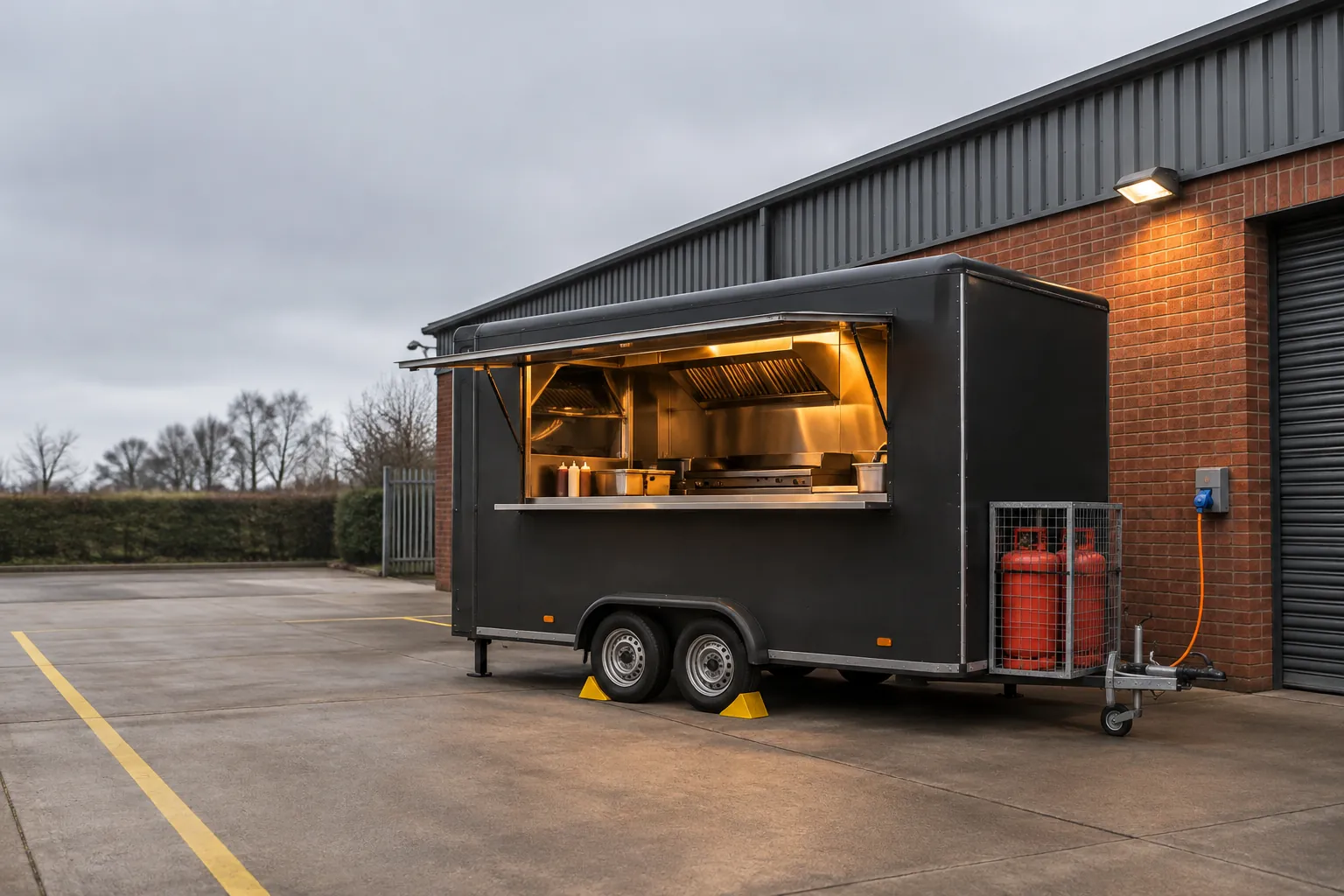
A stand day at your site goes well or badly on a patch of ground most people walk past without looking at. This page sets out what that ground has to be, what the stand brings so that you do not have to, what to measure before you ask, and what rules a spot out.
What your site gives, and what the stand brings
Most of a stand day is carried in on the trailer. What it cannot carry is the ground under it and the way to it.
Your site gives
- Level, firm ground
- Tarmac, concrete or block paving. Grass only when it is dry and firm enough that a loaded trailer will not sink.
- Room for the stand
- For planning, about eight metres by four of that ground for the stand and the space the crew works in. The exact measurements of the unit come with the written confirmation.
- A way in
- Wide enough for a towed trailer, with nothing low overhead and room to turn.
- Ground in front of the hatch
- Clear, so the queue stands off any route a vehicle uses.
- A named person
- Someone on site who meets the stand, knows the site rules and can move a parked van if it has to be moved.
The stand brings
- Water, both ways
- Clean water in its own tank; grey water held in its waste tank and taken away. You need no tap.
- Gas
- Its own cylinders, upright and caged, feeding appliances that cut the gas if a flame goes out.
- Power, if you have none
- A generator, placed away from doors, the queue and anything that should not breathe its exhaust.
- Hand-washing
- Its own basin, with hot water, soap and drying.
- Waste, all of it
- Bags for food waste and packaging, and a sealed container for fats and oils. Nothing goes in your bins unless you agree.
A pitch, seen from above
Not a plan of any real site: the order things sit in, which is the same on every pitch. The numbers on the drawing match the list.
- The stand and its working room, on level ground, chocked, with space all round.
- The gas cage at the towing end, away from drains and openings.
- Awning and ledge on the hatch side, open sky above the flue.
- The queue in front of the hatch, on the people side of a line it does not cross.
- Vehicles keep to their own route beyond that line.
- The cable runs along the wall from your socket, never across a walkway.
Measure it like this
Ten minutes with a tape before you ask saves a wasted morning. Each answer has a box of its own on the request form.
- The narrowest point on the way inGate posts, bollards, a tight bend between buildings. Goes in “How a trailer reaches the pitch”.
- The lowest point overheadA height barrier, a canopy, a pipe bridge, low branches. Same box.
- The ground itselfLength and depth of the space, what it is surfaced with, and whether it slopes enough for a dropped ball to roll away. Goes in the surface choice and the access box.
- The walk from the doorWhere people come out at the bell, and how far that is from the pitch. Goes in “Where the queue stands”.
- The nearest socketWhether there is a 13 A or a 16 A outdoor socket within a cable's reach of the pitch, and whether you are happy for it to be used. Goes in the power choice.
- When the gate is openThe earliest time the stand can drive in, and anything on site that day that changes the yard. Goes in “Anything else”.
Power, water and gas
Power
The cooking is on gas. Electricity runs the fridge, the lights and the water pump, from a 13 A or 16 A socket if you can spare one, or from the stand's generator if not. A cable is run along a wall or kept clear of where people walk, never across a doorway.
Water
Clean water comes in the stand's own tank, and every drop it uses goes back out in its waste tank, to be emptied where grey water is meant to go. Nothing is tipped onto your yard or down your drains.
Gas
Bottled gas, heavier than air, so the cylinders stand upright and secured in their cage, away from drains, gullies and cellar openings where leaking gas could gather. The installation is checked by a Gas Safe registered engineer before the first service.
What rules a spot out
Any one of these, and the stand looks for another spot on your site or another day.
- A slope the trailer's jacks cannot bring level.
- Branches, cables or a canopy above where the flue would stand.
- A fire exit, a fire assembly point or a delivery bay the queue would block.
- A drain, a gully or a cellar opening right beside the gas cage.
- Inside a building, or under a covered loading area.
- A queue that would have to cross the route forklifts or lorries use.
- Ground soft enough that a loaded trailer would sink into it.
- Strong wind on an exposed pitch, on the day itself.
Whose permission the pitch needs
On your firm's own ground
- Your firm's agreement, given in the written confirmation
- The landlord's too, if your firm rents the site and the lease asks for it
- Your site's own rules and any induction, which the crew follows
On a street, or anyone else's land
- Street-trading consent from the council for a pitch on a street
- The landowner's or organiser's agreement anywhere else
- The stand's own food business registration, made before the first service
The paperwork the stand itself needs is listed on Before the bell; each item is shown on this site when it is in place, and not before. How a booked day then runs, hour by hour, is on A day at your gate.
Registered details
The registered office is a private address for post and filings. No food is cooked, sold or collected there.
- Registered name
- MZ SOLUTIONS LTD
- Company number
- 17430729
- D-U-N-S
- 235118560
- Registered in
- England and Wales
- Incorporated
- 1 September 2026
- Registered office
- 107 Coventry Street KIDDERMINSTER, DY10 2BH United Kingdom
- Activities (SIC)
- 56103 Take-away food shops and mobile food stands · 82990 Other business support service activities not elsewhere classified